Theoretical Motivation
Preliminary theoretical analysis + illustrations for why test-driven localization (issue $\rightarrow$ tests $\rightarrow$ trace-constrained code) reduces localization uncertainty vs direct issue-to-code matching.
One-screen takeaway
Why this can help
- Space compression: retrieved tests induce a trace-covered subspace $L_{\text{cov}}$ with $N_{\text{cov}} \ll N$, shrinking the combinatorial search space.
- Failure modes become explicit: (i) weak test selection (few effective tests), (ii) coverage gap ($g_{\text{excl}} > 0$) where some ground-truth edits lie outside trace coverage.
- Design guidance: maximize $\Delta H$ by (a) improving test retrieval precision, (b) refining trace analysis to shrink $N_{\text{cov}}$ while preserving true edits inside the retained subspace.
Where this fits in the artifact
- Illustrative success/failure stories: Case Studies.
- This page focuses on: insight + interpretable examples.
Quick links
2) Entropy proxy
3) Direct uncertainty
4) Test-driven uncertainty
5) Partition diagram
6) Entropy gain & design implications
7) Case studies
8) Scope & limitations
1) Setup & notation
Given an issue description $d$ and repository $R$, let $L$ be the universe of candidate locations (e.g., all functions/methods) with $N = |L|$. Let $\mathcal{G}\subseteq L$ be the ground-truth edit set. Any localization system returns a ranked list of locations under a budget $k_{\text{ret}}$; the returned set is $L_{\text{ret}}$ with $|L_{\text{ret}}|=k_{\text{ret}}$.
$L$: all candidate locations
$N=|L|$: size of global space
$\mathcal{G}$: ground-truth edit set
$k_{\text{test}}$: number of retrieved tests
In the test-driven pipeline, we retrieve a fixed-size set of tests $\hat{\mathcal{T}}_d$, $|\hat{\mathcal{T}}_d|=k_{\text{test}}$. Each test $t$ has a dynamic coverage set $\text{Cov}(t) \subseteq L$. The trace-constrained subspace is their union:
$$L_{\text{cov}} = \bigcup_{t\in \hat{\mathcal{T}}_d}\text{Cov}(t), \qquad N_{\text{cov}} = |L_{\text{cov}}|.$$
2) Entropy proxy (uncertainty as combinatorial ambiguity)
We approximate uncertainty with Hartley entropy: $$H(\mathcal{C}) \approx \log_2|\mathcal{C}|,$$ capturing the ambiguity of selecting correct edits from a candidate set. We do not estimate the intractable distribution $P(L\mid d)$; instead, we quantify relative uncertainty reduction induced by hierarchical retrieval and trace constraints.
3) Direct retrieval uncertainty
A direct method ranks the entire space $L$ and returns $L_{\text{ret}}$. Let $g_{\text{ret}} = |\mathcal{G}\cap L_{\text{ret}}|$ denote how many ground-truth edits fall inside the returned set. We use a partition-based proxy that explicitly accounts for whether true edits fall inside or outside $L_{\text{ret}}$:
$$ \begin{aligned} H_{\text{direct}} ={}& 1[g_{\text{ret}} > 0]\cdot \Big(-\log_2 \frac{g_{\text{ret}}}{|L_{\text{ret}}|}\Big) + 1[|\mathcal{G}|-g_{\text{ret}} > 0]\cdot \Big(-\log_2 \frac{|\mathcal{G}|-g_{\text{ret}}}{N-|L_{\text{ret}}|}\Big). \end{aligned} $$
4) Test-driven (indirect) uncertainty
Test-driven localization decomposes the search into two stages: (i) retrieving requirement-relevant tests, and (ii) localizing within a trace-constrained subspace. We model uncertainty as the sum of stage-wise entropies, making realistic failure modes explicit.
Stage 1 — Test selection entropy
A retrieved test is effective if it covers at least one ground-truth location: $\text{Cov}(t)\cap \mathcal{G}\neq\emptyset$. Let $n$ be the number of effective tests in $\hat{\mathcal{T}}_d$.
$$H_{\text{stage1}} = 1[n>0]\cdot \Big(-\log_2 \frac{n}{k_{\text{test}}}\Big).$$
Stage 2 — Trace-constrained localization entropy
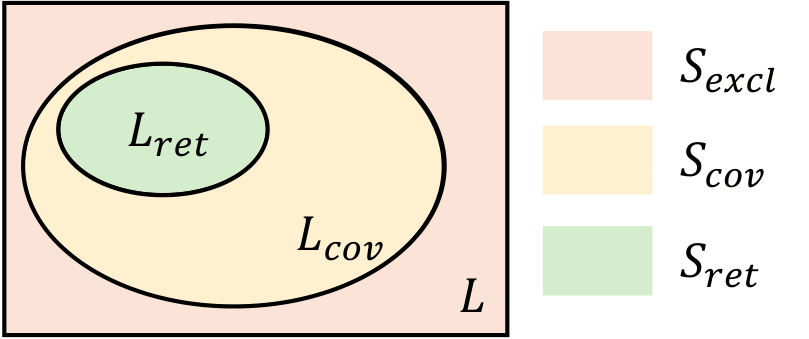
We partition the global space into three disjoint regions induced by the trace subspace and the returned top-$k_{\text{ret}}$ locations. Critically, in the test-driven pipeline, $L_{\text{ret}}\subseteq L_{\text{cov}}$.
$$S_{\text{ret}} = L_{\text{ret}}, \quad S_{\text{cov}} = L_{\text{cov}} \setminus L_{\text{ret}}, \quad S_{\text{excl}} = L\setminus L_{\text{cov}}.$$
Let $N_i=|S_i|$ and $g_i=|\mathcal{G}\cap S_i|$ for $i\in\{\text{ret},\text{cov},\text{excl}\}$. Define:
$$H_{\text{stage2}} = \sum_{i\in\{\text{ret},\text{cov},\text{excl}\},\, g_i>0} \Big(-\log_2 \frac{g_i}{N_i}\Big).$$
- Space compression: if $N_{\text{cov}}\ll N$, uncertainty shrinks because the search space is smaller.
- Coverage penalty: if $g_{\text{excl}}>0$ (some true edits outside trace coverage), the penalty term can dominate.
The hierarchical uncertainty is: $$H_{\text{indirect}} = H_{\text{stage1}} + H_{\text{stage2}}.$$
5) Partition diagram (Venn)
6) Entropy gain & design implications
For each issue, define empirical uncertainty reduction: $$\Delta H = H_{\text{direct}} - H_{\text{indirect}}.$$ A positive $\Delta H$ indicates that introducing tests and traces reduces localization ambiguity compared to direct matching under the same return budget $k_{\text{ret}}$.
Design implications (how this motivates IssueExec)
Maps to:
- Domain knowledge enhancement (commit messages + co-changed entities) to bridge terminology gaps.
- Two-phase retrieval: lexical filtering (BM25) for recall, LLM selection for precision.
Maps to:
- Trace-guided localization: use call hierarchy + pruning; identify sparse suspicious set.
- Refinement & reranking: expand structurally related candidates + code-aware rerank to improve top-k precision.
7) Case studies
This page prioritizes case-driven interpretability. We provide representative mini cases with intermediate quantities (set sizes and overlaps) to illustrate how $\Delta H$ is computed and why it becomes positive/negative. Full narratives and raw artifacts are linked from each case.
Case A — Space compression success
Instance: sympy-Issues-19747
· Budgets: k_test=5, k_ret=10, gt_threshold=1.0
· Gain: ΔH = 15.46 bits
· External failure: No
N=28222 shrinks to N_cov=626 (~45.1× smaller),
and all GT edits are covered (g_ext=0), so indirect uncertainty is tiny.
| Item | Value | Notes |
|---|---|---|
| Full case page | case_sympy.html | Inspectable artifacts (tests, top-k, GT) + computed terms. |
| Global space | N = 28222 | All candidate code locations. |
| Trace subspace | N_cov = 626 | Union coverage of selected tests. |
| GT size | |G| = 2 | Two GT edit locations. |
| Direct hits | g_ret_direct = 1 | Direct top-10 includes 1 GT. |
| Indirect hits | g_ret_indirect = 2 | Indirect top-10 includes both GT. |
| Effective tests | n_effective = 4 / 5 | Stage1 is small. |
| Coverage gap | g_ext = 0 | No GT outside trace coverage. |
Computed entropy terms (from this instance)
H_direct   = 18.105949419261542
      H_stage1   = 0.3219280948873623
      H_stage2   = 2.321928094887362
      H_indirect = 2.6438561897747244
      ΔH         = 15.462093229486818
Case B — External failure (coverage gap)
Instance: xarray-Issues-3992
· Budgets: k_test=5, k_ret=10, gt_threshold=1.0
· Gain: ΔH = -1.55 bits
· External failure: Yes
N=2011 → N_cov=271, ~7.4× smaller),
two GT edits are outside trace coverage (g_ext=2), and only 1/5 retrieved tests is effective,
so indirect uncertainty becomes larger than direct.
| Item | Value | Notes |
|---|---|---|
| Full case page | case_pydata__xarray.html | Inspectable artifacts (tests, top-k, GT) + computed terms. |
| Global space | N = 2011 |
All candidate code locations. |
| Trace subspace | N_cov = 271 |
Union coverage of selected tests (L_sub_size). |
| GT size | |G| = 4 |
Four GT edit locations. |
| Direct hits | g_ret_direct = 1 |
Direct top-10 includes 1 GT. |
| Indirect hits | g_ret_indirect = 2 |
Indirect (trace-constrained) top-10 includes 2 GT. |
| Effective tests | n_effective = 1 / 5 |
Stage1 is large: H_stage1 = -log2(1/5) = 2.3219. |
| Coverage gap | g_ext = 2 |
Two GT locations fall outside trace coverage (external penalty). |
| Outcome | ΔH = -1.553 (negative) | H_direct=12.703, H_indirect=14.257. |
Computed entropy terms (from this instance)
H_direct   = 12.703471046071947
    H_stage1   = 2.321928094887362
    H_stage2   = 11.934796592178403
    H_indirect = 14.256724687065764
    ΔH         = -1.5532536409938178
Evidence snippet (coverage summary)
- Selected tests (k_test=5):
      xarray/tests/test_dataset.py::test_differentiate
      xarray/tests/test_dataset.py::test_integrate
      xarray/tests/test_dataset.py::TestDataset.test_expand_dims_mixed_int_and_coords
      xarray/tests/test_concat.py::test_concat_merge_single_non_dim_coord
      xarray/tests/test_dataset.py::TestDataset.test_dataset_diff_n2

    - Union coverage size:
      N_cov = 271  (L_sub_size)

    - GT locations (|G|=4):
      xarray/core/dataarray.py::DataArray.integrate
      xarray/core/dataset.py::Dataset.integrate
      xarray/core/dataarray.py::DataArray.map_blocks
      xarray/core/dataarray.py::DataArray.unify_chunks

    - Uncovered GT (g_ext=2):
      xarray/core/dataarray.py::DataArray.map_blocks
      xarray/core/dataarray.py::DataArray.unify_chunks
8) Scope & limitations
- This analysis is a preliminary motivation for the test-driven paradigm; it does not claim universally positive gains for every project.
- The entropy proxy is not a calibrated posterior; it is an interpretable measure of combinatorial ambiguity.
- External failure ($g_{\text{excl}}>0$) is expected when tests do not cover the ground-truth edits; this motivates refinement and broader candidate expansion.
- Trace collection has overhead; IssueExec treats trace collection primarily as offline preprocessing and uses pruning/compression to fit context.
Link to bad cases illustrating limitations
- Coverage gap example: Bad Case 1
- Trace noise / infra dominance example: Bad Case 2 (placeholder)