Empirical Study
Empirical validation for the premise that tests act as executable requirements for issue localization. We evaluate three hypotheses: H1 Coverage feasibility, H2 Retrievability, and H3 Bridging effect.
One-screen takeaway
Key results (paper-ready)
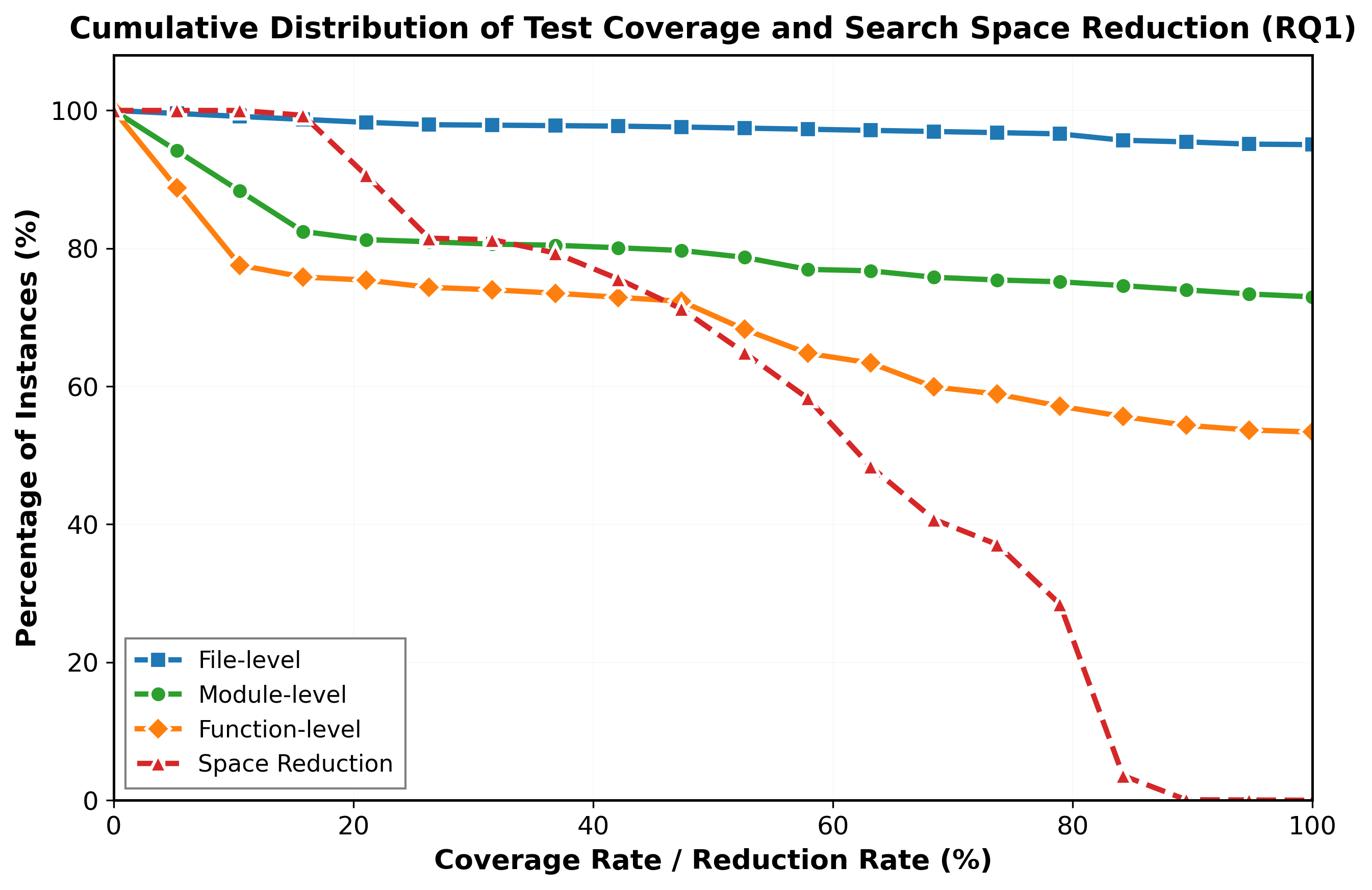
- H1: Mean coverage: 96.98% (file), 66.70% (function). Search space reduces to 58.39% on average.
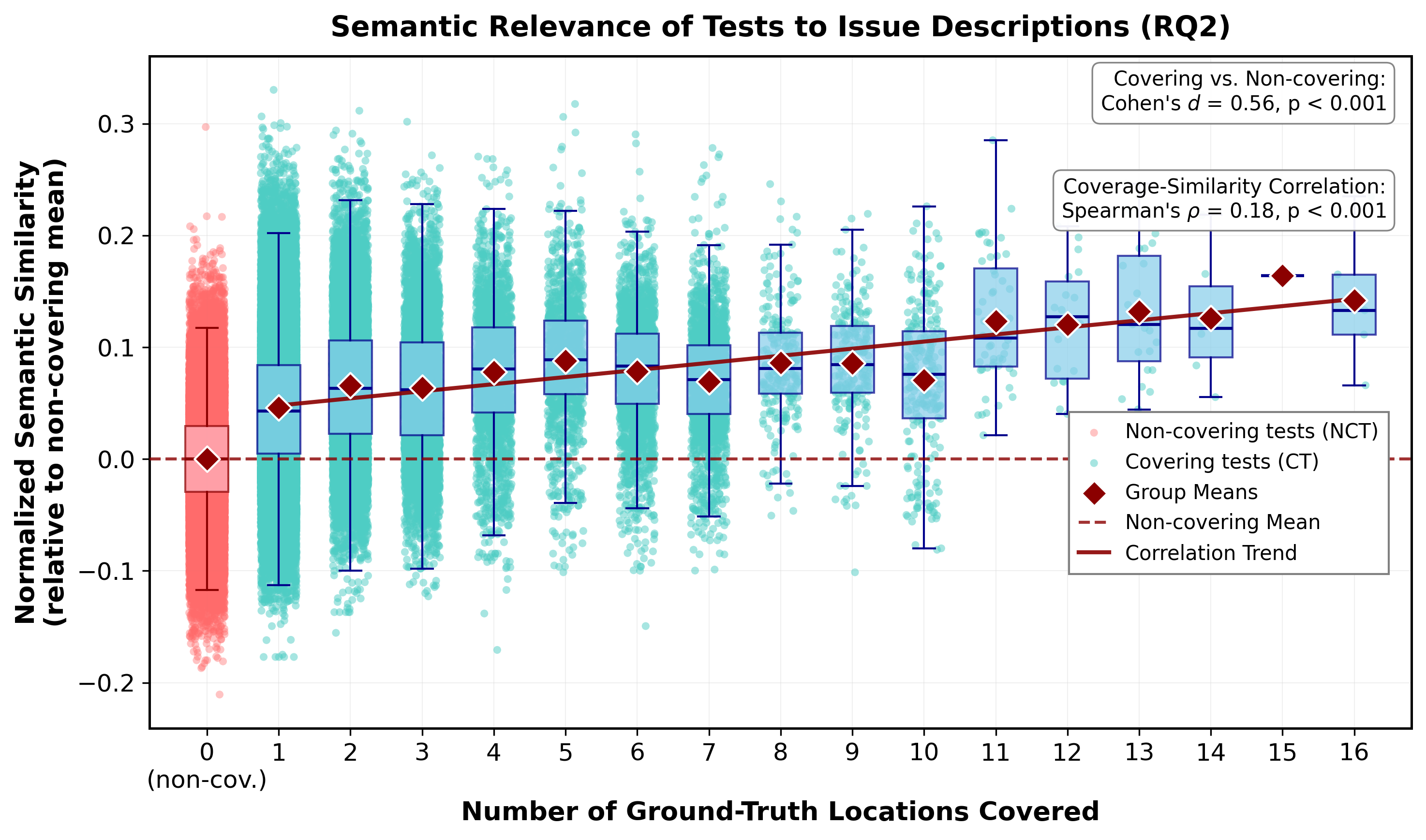
- H2: Covering tests win in 90.9% of instances (paired t-test $p < 0.001$; Cohen’s $d \approx 0.56$). Correlation: Spearman’s $\rho \approx 0.18$ ($p < 0.001$).
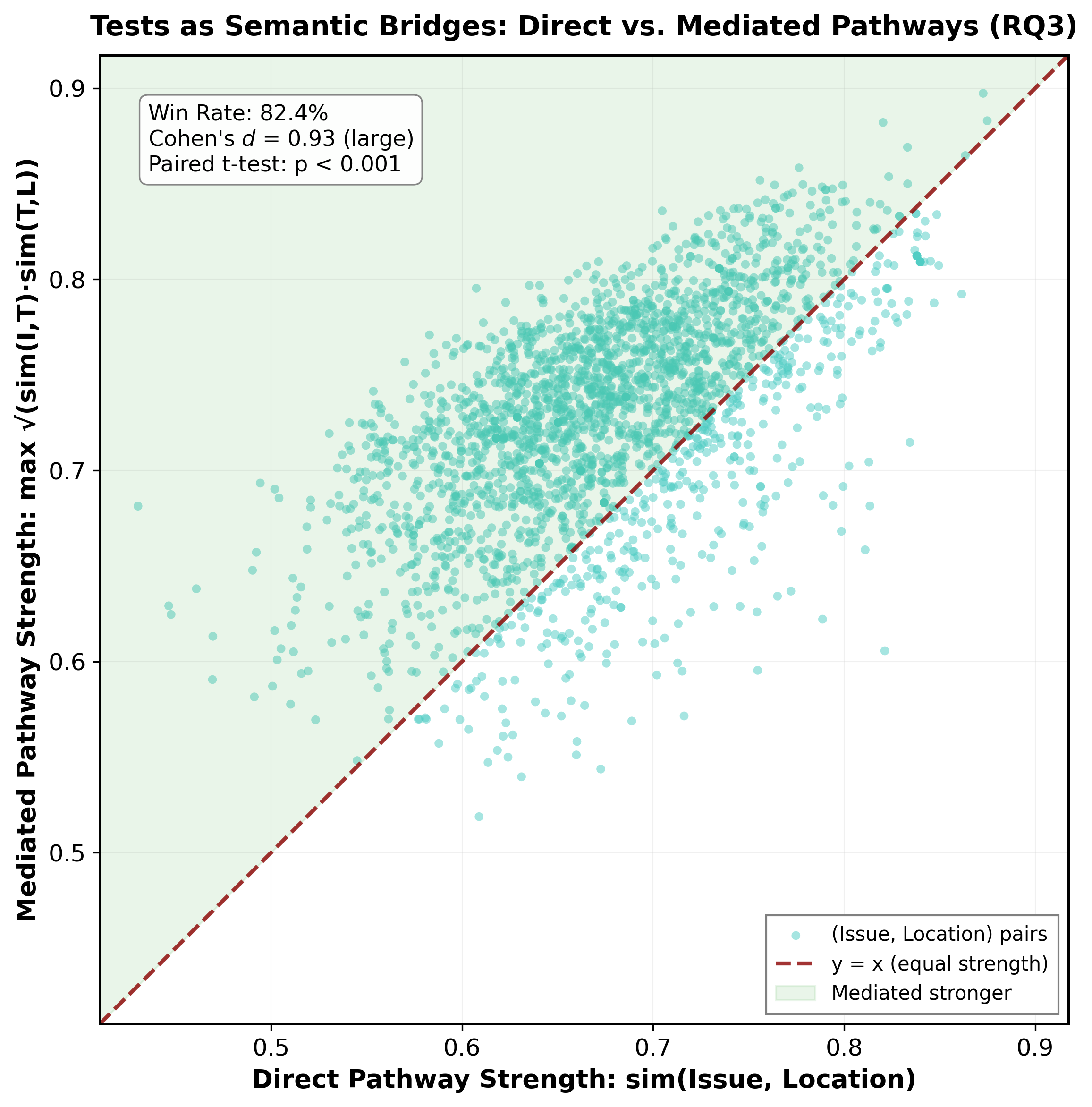
- H3: Mediated pathway is stronger in 82.4% of (issue, location) pairs (paired t-test $p < 0.001$; Cohen’s $d \approx 0.93$).
Where this fits in the artifact
- System pipeline overview: see the paper Section 4 and the Case Studies.
- This page focuses on: empirical evidence and how it informs IssueExec’s design.
Quick links
2) Dynamic trace collection
3) H1 — Coverage feasibility
4) H2 — Retrievability
5) H3 — Bridging effect
6) Implications for IssueExec
7) Notes & limitations
1) Setup
We study whether tests can serve as executable requirements for localizing software engineering issues. The dataset includes 929 issue instances drawn from SWE-bench and SWE-bench Gym across 18 popular Python repositories. Each repository-issue pair is executed in a containerized environment reset to its pre-patch state. To prevent environment configuration errors from confounding results, we retain instances where the test environment is sufficiently robust (at least 50% of test functions execute successfully).
2) Dynamic trace collection
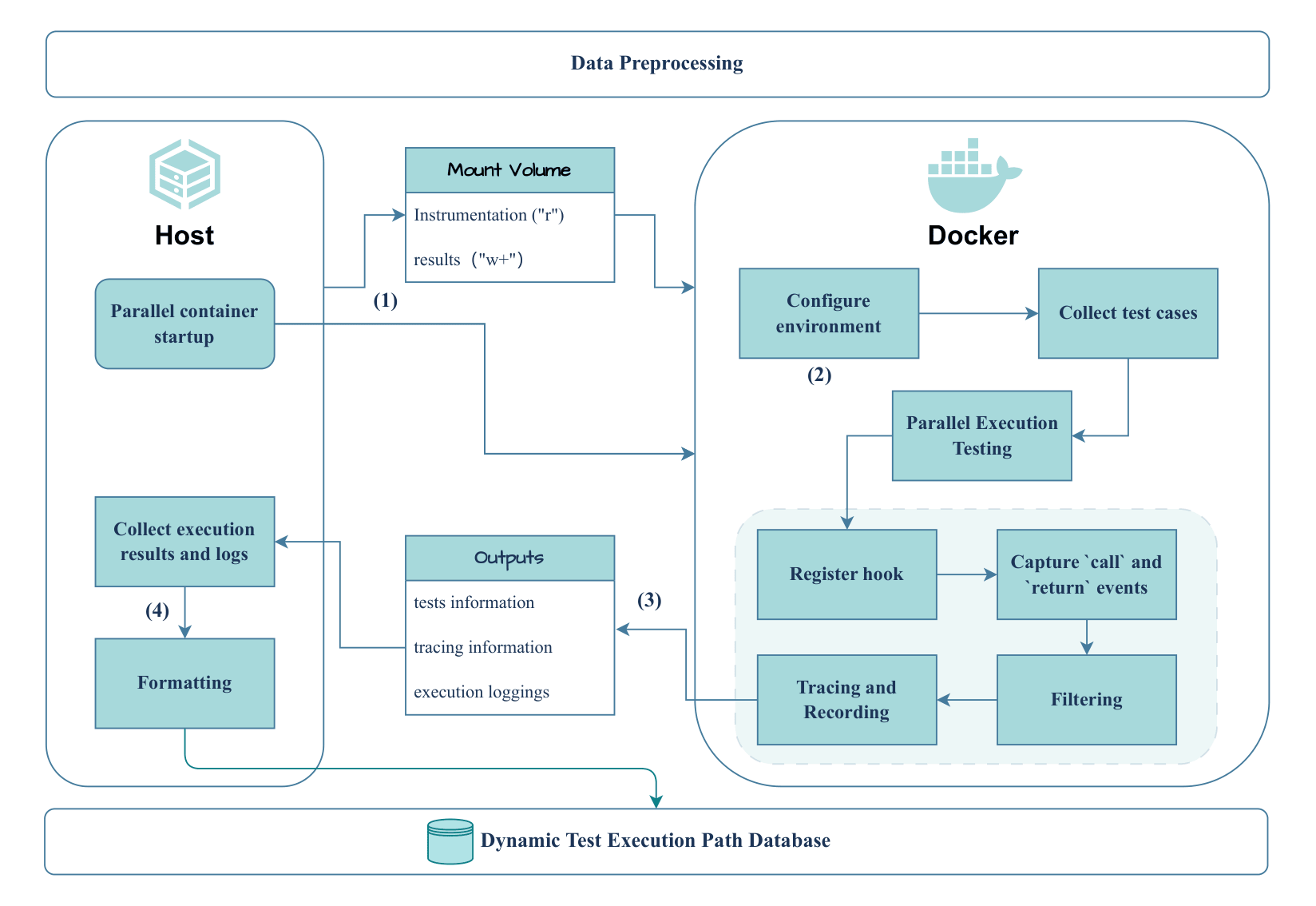
We collect function-level execution traces during test runs and retain only repository-internal functions. Standard library and third-party dependency calls are filtered out, and remaining functions are represented by their fully-qualified paths.
What is counted as "covered"?
A code location is considered covered if it appears in the repository-internal function call trace of at least one executed test. Coverage is evaluated at three granularities: file, module (class or top-level function), and function. For search space reduction, we compare the size of the union of test-covered internal functions to the total number of internal functions in the repository for each instance.
3) H1 — Coverage feasibility
H1 evaluates whether dynamic execution signals already exist in typical repositories. By intersecting test traces with the ground-truth edit sets, we measure how often tests reach the true edit locations and how much the candidate space can be compressed by trace-induced constraints.
Summary statistics (929 instances)
| Metric | Mean | Median | Std | Min | Max |
|---|---|---|---|---|---|
| File-level coverage | 0.9698 (96.98%) | 1.0000 (100.00%) | 0.1550 | 0.0000 | 1.0000 |
| Module-level coverage | 0.7804 (78.04%) | 1.0000 (100.00%) | 0.3933 | 0.0000 | 1.0000 |
| Function-level coverage | 0.6670 (66.70%) | 1.0000 (100.00%) | 0.4178 | 0.0000 | 1.0000 |
| Search space (union coverage / total) | 0.5839 (58.39%) | 0.6188 (61.88%) | 0.2268 | 0.1117 | 0.8523 |
Threshold hit rates
| Granularity | ≥ 75% | ≥ 90% |
|---|---|---|
| File-level | 898 / 929 (96.7%) | 886 / 929 (95.4%) |
| Module-level | 700 / 929 (75.3%) | 686 / 929 (73.8%) |
| Function-level | 546 / 929 (58.8%) | 504 / 929 (54.3%) |
Raw report (H1)
RQ1: Coverage Statistics Report (Generated: 2026-01-05)
- Total Instances: 929
- File-level Mean: 0.9698
- Module-level Mean: 0.7804
- Function-level Mean: 0.6670
- Space Reduction Mean: 0.5839
4) H2 — Retrievability
H2 checks whether covering tests are distinguishable from non-covering tests via semantic signals. We compare similarity between the issue description and (i) tests that cover at least one ground-truth location and (ii) baseline tests sampled from the same repository that do not cover ground-truth locations.
Instance-level statistics (recommended)
| Statistic | Value | Notes |
|---|---|---|
| Win rate (covering > non-covering mean) | 90.9% | Across valid instances, covering tests show higher similarity than non-covering tests. |
| Paired t-test (per-instance means) | $p < 0.001$ (t = 38.8015) | Significant advantage of covering tests over non-covering tests. |
| Effect size (Cohen’s d) | 0.5573 | Medium-to-large practical effect. |
| Correlation (#GT covered vs similarity) | $\rho = 0.1809$, $p < 0.001$ | Tests covering more ground-truth locations tend to be more semantically aligned with the issue. |
Raw report (H2)
RQ2: Semantic Similarity Statistics Report (Generated: 2026-01-05)
- Valid instances: 536
- Win rate: 90.9%
- Paired t-test p-value: 1.203337e-157
- Cohen's d: 0.5573
- Spearman ρ: 0.1809 (p < 0.001)
Why instance-level analysis?
Similarity distributions vary across repositories and test suites. Comparing covering vs non-covering tests within each issue instance provides a more stable estimate of semantic distinguishability and reduces cross-project confounding.
5) H3 — Bridging effect
For each (issue, location) pair where coverage exists, we compare direct similarity $s_{\text{direct}}=\mathrm{sim}(\text{issue}, \text{location})$ against a test-mediated pathway strength:
$$s_{\text{mediated}} = \max_{t \in \mathcal{T}_{\text{cover}}} \sqrt{\mathrm{sim}(\text{issue}, t)\cdot \mathrm{sim}(t,\text{location})}$$
This geometric-mean form ensures a strong bridge requires balanced semantic associations across both hops: Issue $\rightarrow$ Test and Test $\rightarrow$ Location.
Summary statistics (2416 pairs)
| Statistic | Value | Notes |
|---|---|---|
| Direct pathway mean (std) | 0.6745 (0.0681) | $s_{\text{direct}}$ |
| Mediated pathway mean (std) | 0.7271 (0.0576) | $s_{\text{mediated}}$ |
| Win rate (mediated > direct) | 82.4% (1991 / 2416) | Bridging effect holds for most pairs. |
| Paired t-test | $p < 0.001$ (t = 45.4641) | Highly significant difference. |
| Wilcoxon signed-rank | $p < 0.001$ (W = 2,633,234) | Non-parametric confirmation. |
| Effect size (Cohen’s d) | 0.9251 (large) | Substantial practical improvement. |
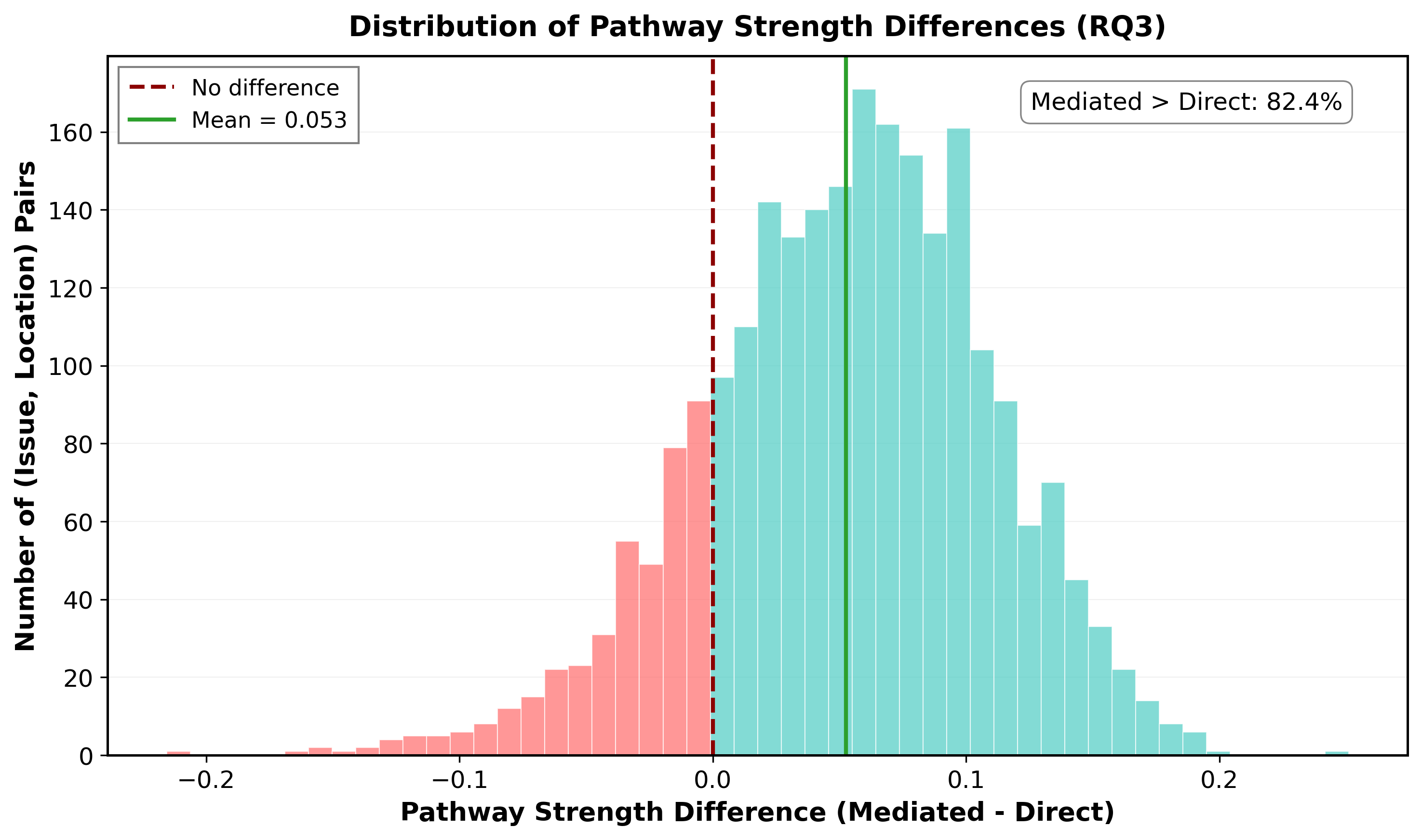
Raw report (H3)
RQ3: Tests as Semantic Bridges (Generated: 2026-01-07)
- Pairs analyzed: 2416
- direct_mean: 0.6745, mediated_mean: 0.7271
- Win rate: 82.4%
- Paired t-test: p < 0.001, Cohen's d: 0.9251
Representative examples (format)
You can optionally place a small table of representative (issue, location) pairs here (e.g., a few with large positive deltas and a few with negative/near-zero deltas). Keep it short to avoid overwhelming the page.
| Instance | Location | $s_{direct}$ | $s_{mediated}$ | Best test |
|---|---|---|---|---|
pytest-dev__pytest-11143 |
src/_pytest/assertion/rewrite.py::AssertionRewriter.run |
0.7222 | 0.7567 | testing/test_assertrewrite.py::TestAssertionRewrite.test_rewrites_plugin_as_a_package |
sphinx-doc__sphinx-8548 |
sphinx/ext/autodoc/__init__.py::ClassDocumenter.get_object_members |
0.7573 | 0.8320 | tests/test_ext_autodoc.py::test_autodoc_inherited_members |
6) Implications for IssueExec
The empirical findings directly inform IssueExec’s design choices:
7) Notes & limitations
- Coverage feasibility varies by granularity: file-level coverage is typically higher than function-level coverage, which is expected because a single file may contain multiple functions and only some are executed by existing tests.
- Semantic retrievability is evaluated with within-instance comparisons to mitigate cross-project distribution shifts in test suites.
- The bridging effect is evaluated only on pairs where coverage exists (i.e., at least one covering test is available).
Where to see concrete end-to-end examples
See Case Studies for illustrative good and bad cases, with intermediate artifacts (retrieved tests, trace-guided candidates, and final ranked locations).